
Kemper · Door Style
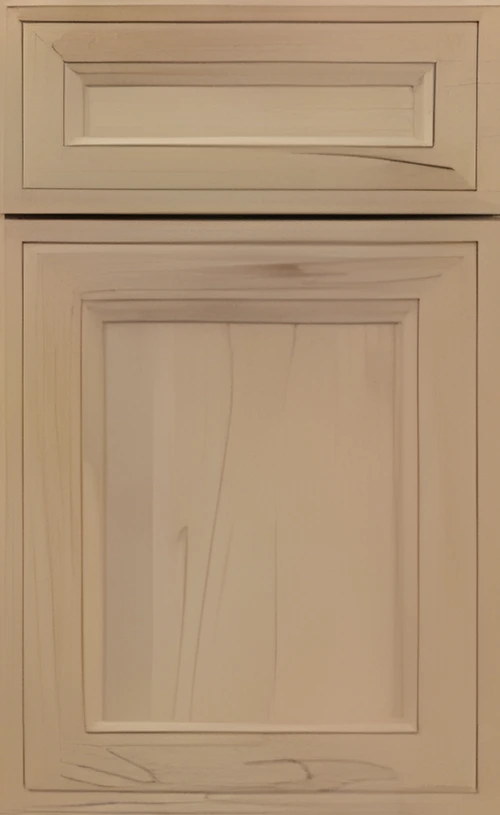
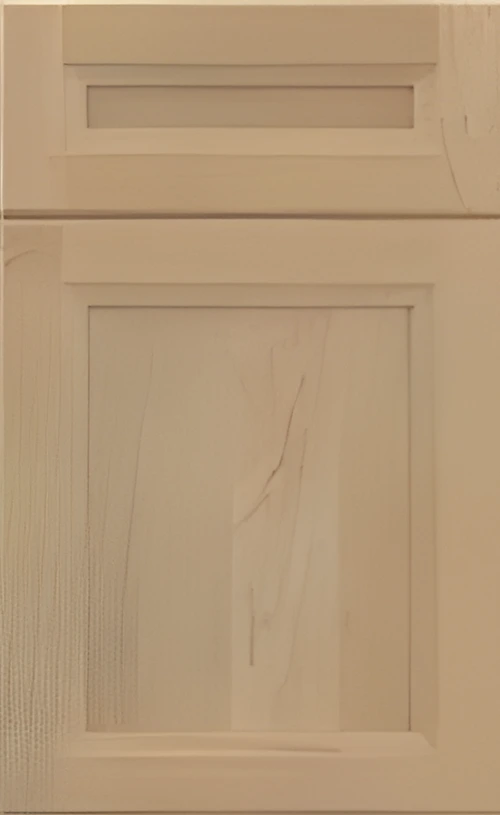
Kemper Warwick Cabinet Door
Offered in the Kemper Choice and Emerge series
Where most recessed panels drop straight to the field, Warwick gets there in stages. The frame steps down, runs flat for a moment, then steps again, laying two shadow lines around every panel. It is the most detailed of the square-cornered doors we show, and it reads refined rather than ornate.
- Brand
- Kemper
- Series
- Choice · Emerge
- Overlay
- Full overlay
Design & Profile
The panel is recessed and flat, but the way the frame reaches it is the whole story. From the face of the stile the profile drops to a narrow shelf, runs level for a moment, then drops again to the panel. That gives you two parallel lines around each opening instead of one, with a band of lit surface held between them. Corners stay square, so the stepped detail turns a hard right angle at every junction.
The frame is wide enough to carry that profile without crowding the panel, and the outer edge of the door is eased rather than left sharp. The drawer front repeats the same stepped surround, compressed — on a narrow drawer the two lines sit close together and read almost as one heavier line. Shadow is the strongest of any door in this group: at a low angle the steps throw a real band of shade, not a hairline.
Across a wall of cabinets that depth adds up. Warwick gives a kitchen furniture-like presence, closer to a built-in than to a run of boxes, which suits a formal room, a library wall or a dining-side hutch. In a compact kitchen the layering can feel busy on every door; keeping it to the perimeter and letting an island stay plainer is one straightforward way to balance it.
Series & Construction
Warwick is a full overlay door, offered in the Kemper Choice and Emerge series. Kemper lists it in Maple, Cherry, Oak, Walnut, Rustic Alder and Quartersawn White Oak.
Kemper has been making cabinetry in America since 1926 and is part of the MasterBrand family. Emerge is Kemper’s most personalized series: all-plywood construction, custom sizing, specialty finishes, stain and glaze options and multiple edge profiles. Kemper backs its cabinetry with a limited lifetime warranty; coverage and terms are set by Kemper.
Kemper shows Warwick as Square.
Finishes
Paint is where the steps pay off. The film gathers very slightly in each inside corner, so both lines darken a shade and the layering reads more clearly than it does in bare wood. On a light paint that is all upside — the door gains depth without gaining weight. On a very dark paint the lines can close up visually, and the profile becomes something you feel at the edge of the door more than something you see.
Glaze has two places to sit on this door, which is unusual. It settles in the inner corner at the panel and again in the corner at the upper step, outlining each panel twice over. The effect is strong, so a light hand matters. In stain, oak and quartersawn white oak run grain straight across both steps, walnut darkens them, and rustic alder breaks the lines up with knots and shifts in color.
Pairing Ideas
Countertops
A detailed door reads best under a calmer top. Cambria Ainsley in near-solid bright white or Cambria Chatsworth in cream lets the stepped frame stay the feature. If you want veining, Cambria Hemsworth keeps its movement soft, while Cambria Galloway in gray gives a stronger pattern and works best when the cabinet run is short.
Countertops we carry →Backsplash
Gloss suits this profile, because the door is already working in shadow. MSI White Glossy Fish Scale and MSI Retro Octagon Bianco both bounce light back onto the steps. For a quieter wall, MSI Zest Sand 2.5x8 in cream lays a simple field behind the counter and leaves the layered frame to carry the detail.
Backsplash tile →Hardware
Warwick can take some weight. The Berenson Swagger 160mm in bronze suits its furniture character, and the Berenson Epoch Edge 128mm in vintage nickel sits comfortably against the stepped frame. Keep the pull proportionate to the frame width — a very slim bar tends to look lost on a profile this deep.
Pulls & knobs →Floors
Solid or engineered hardwood matches the furniture feel of the door, especially in a mid to deep tone that echoes the shadow in the frame. Porcelain tile in a stone look works in a bath or a back entry. Avoid a heavily patterned floor; between the steps on the doors and a busy floor, the room runs out of quiet.
Flooring →Frequently Asked Questions


Plan a Kitchen with Warwick
Tell us about your room and we will help you decide whether Warwick is the right call, then design, order and install it.
Or call: (630) 733-7700