
Kemper · Door Style
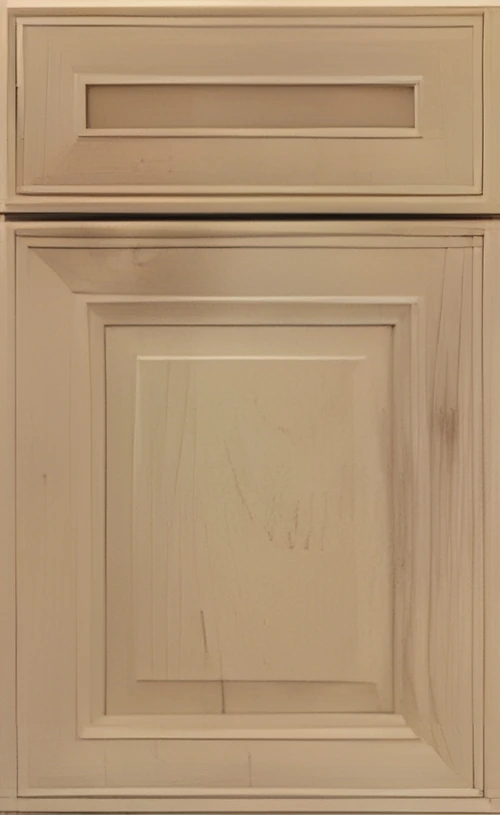
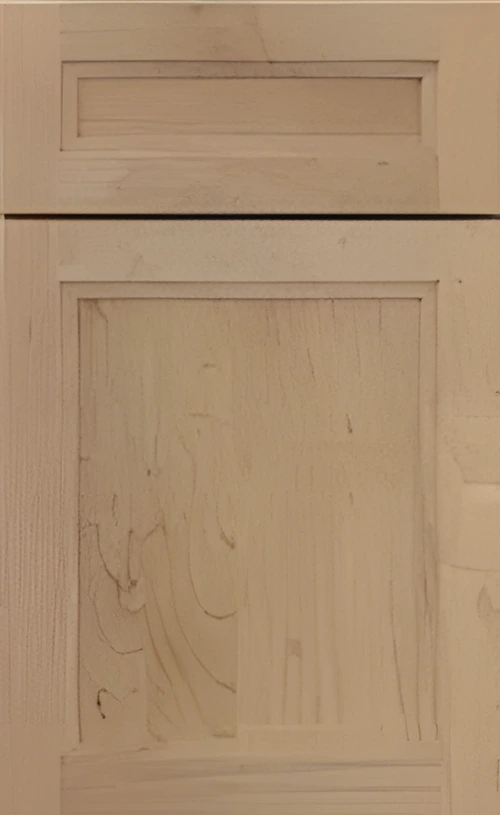
Kemper Canby Cabinet Door
Offered in the Kemper Choice series
Mitered corners, a stepped frame and a raised panel inside it. Canby is the most formal door in this group, and the only one whose frame corners run on a diagonal rather than butting square. It belongs in a traditional kitchen, a dining room built-in or a bath where cabinetry is meant to read as furniture.
- Brand
- Kemper
- Series
- Choice
- Overlay
- Full overlay
Design & Profile
The frame is mitered: stiles and rails meet on a forty-five degree joint at each corner, so the molded profile runs continuously around the opening instead of stopping at a butt joint. That profile is stepped — down from the face, across a flat, then down again — and inside it the panel rises to a broad flat field on a soft shoulder. Four layers of surface, then, between the outer edge of the door and the center of the panel.
The miter is what you notice first. Because the molding turns the corner rather than butting into it, your eye follows an unbroken line all the way around every panel, which is exactly how a picture frame or a cased opening is built. The drawer front uses the same mitered, stepped surround compressed into a narrow band, with a slim recessed center. Shadow is layered and continuous, two lines around the frame plus the gradient on the panel shoulder.
This is a door with opinions. Across a full kitchen it builds genuine formality, especially with crown, a furniture base and a built hood. On a dining hutch or a library wall it is entirely at home. What it will not do is disappear, so in a casual or very small room it can be more than the space wants. One option there is to use it on a single furniture piece and keep the working cabinetry plainer.
Series & Construction
Canby is a full overlay door, offered in the Kemper Choice series. Kemper lists it in Maple and Cherry.
Kemper has been making cabinetry in America since 1926 and is part of the MasterBrand family. Choice carries Kemper’s construction into a wider range of door styles, a deeper palette of colors and finishes, and more functional storage. Kemper backs its cabinetry with a limited lifetime warranty; coverage and terms are set by Kemper.
Kemper shows Canby as 5-Piece.
Finishes
Paint and a mitered frame are a natural pair, because the continuous molding gives the film one unbroken run and the inside corners of the steps pick up just enough build to darken the lines. In a soft white the door reads as millwork rather than as cabinetry. Glaze is the other classic treatment here: it settles into both steps and follows them around the miter, outlining each panel twice and pulling the whole profile forward.
Both of the woods offered for this door are close-grained enough to take a complex molding cleanly, which is rather the point. Maple is the one to choose for a painted finish, since nothing telegraphs through the steps and the profile stays sharp. Cherry is the choice for stain: it has the color depth to match the door’s formality, it warms further over the years, and its grain runs calmly enough not to fight the molding.
Pairing Ideas
Countertops
A formal door wants a composed top. Vicostone Venatino, a bright white quartz with marble-look veining, suits it without going theatrical, and Cambria Darlington in cream is the warm, quiet version. If the cabinetry is painted dark, Vicostone Lacus or Vicostone Volakano in near-solid white give the contrast the profile needs to read.
Countertops we carry →Backsplash
Shaped tile echoes the molding. MSI Victorian Light Arabesque is the most traditional partner, and MSI Stonella Hexagon gives shape in a cooler gray. For a wall that stays in the background and lets the mitered frames carry the room, MSI Ravello Mini Stack in polished gray is the restrained option.
Backsplash tile →Hardware
Canby can carry ornament, and it can also be grounded by restraint. The Berenson Epoch Edge 128mm in vintage nickel suits the period feel, while the Berenson Swagger 160mm in bronze adds weight. Modern hardware is not off limits either — a simple brushed gold pull against a mitered frame is a deliberate, current contrast.
Pulls & knobs →Floors
Hardwood, ideally with some formality of its own: a narrower board, a quartersawn look, or a herringbone lay in a dining room. Keep the tone related to the cabinetry rather than identical to it. In a bath, porcelain tile in a stone or marble look carries the same dressed feel without the moisture worries of wood.
Flooring →Frequently Asked Questions


Plan a Kitchen with Canby
Tell us about your room and we will help you decide whether Canby is the right call, then design, order and install it.
Or call: (630) 733-7700