
Countertops, Honestly: What You're Actually Buying
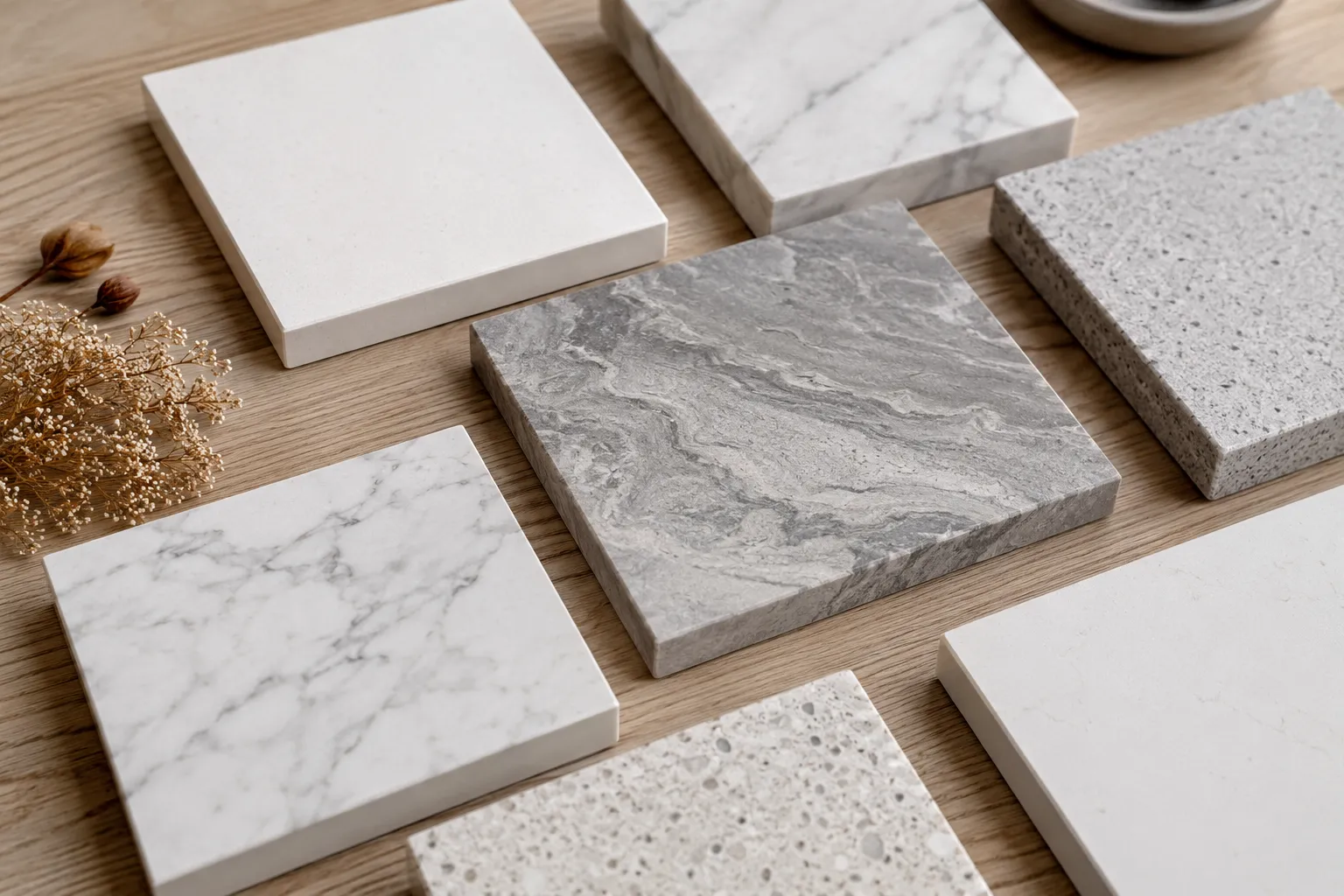
Most people shop for countertops with their eyes and then live with them with their hands.
You choose the slab in a showroom — good lighting, standing up, coffee in hand, everything looking its best. Then you live with it at seven in the morning with a kid, a leaking container of raspberries, and a hot pan that needs somewhere to land. Those are two very different relationships with the same piece of stone, and the gap between them is where most countertop regret begins.
So let’s talk about what these materials actually do once they’re in your house.
One note before we start: there is no single best countertop. There’s the one that fits how you cook, how much upkeep you’ll genuinely tolerate, and whether you want something unique or something predictable. Anyone who tells you one material wins every time is selling that material.
Quartz
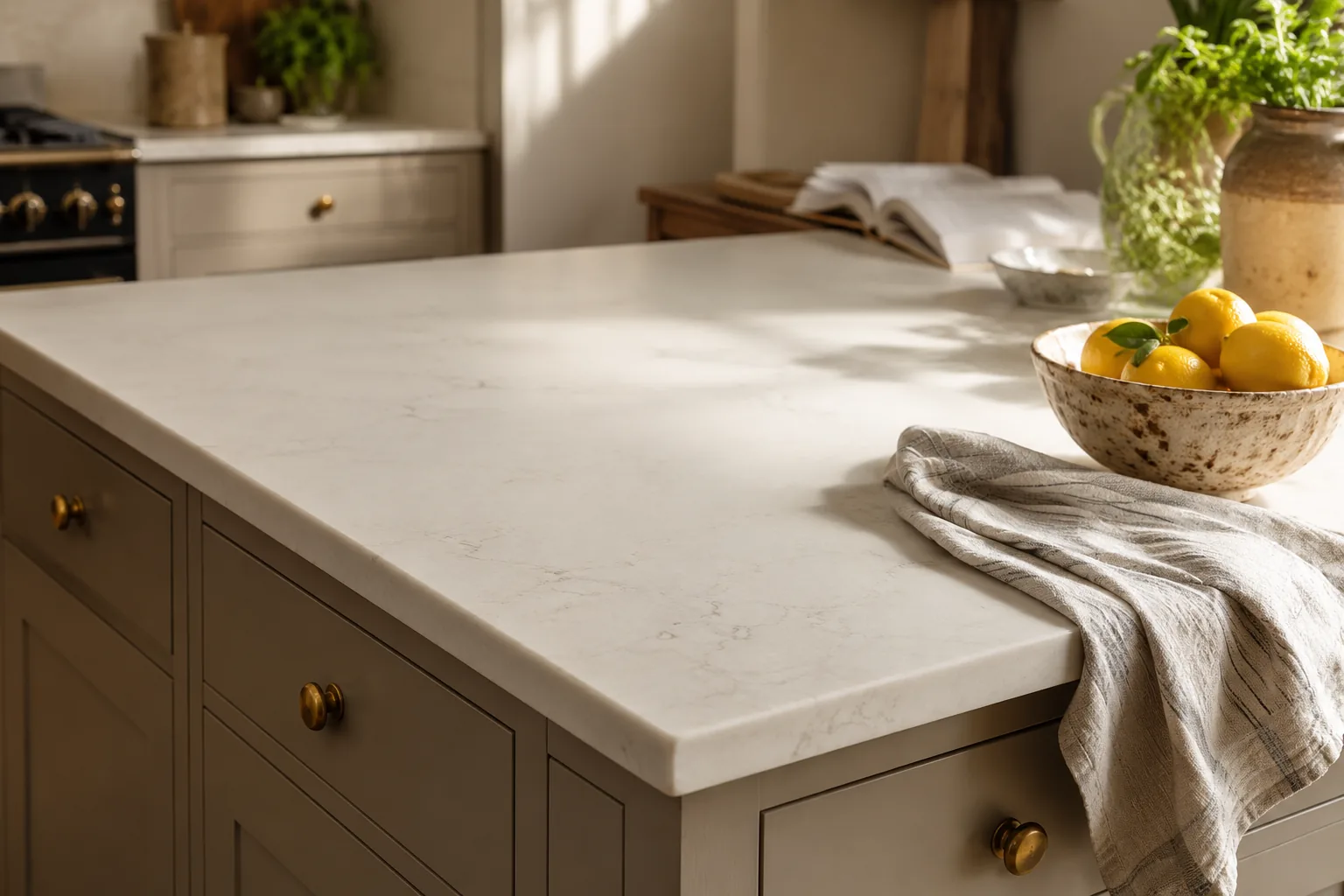
The engineered option — ground quartz combined with resin and pigment, manufactured rather than quarried. Cambria and Vicostone both live here.
Its great advantage is that it’s non-porous. No sealing, ever. Red wine, olive oil, tomato sauce, whatever’s been leaking in the back of the fridge — you wipe it and the matter is closed. And because it’s manufactured, the slab you approve is the slab you get. There are no surprises on delivery day.
The trade-off is heat. Quartz contains resin, and resin does not tolerate a 450-degree pan. Set a hot skillet down directly and you risk scorching or cracking the surface, and that damage doesn’t buff out. Trivets are not optional. It’s also worth asking about direct sunlight if you’re putting it on a sunny island, since products vary in how well they hold up.
If your honest answer to “will you reseal this every year?” is no, this is likely your material.
Quartzite
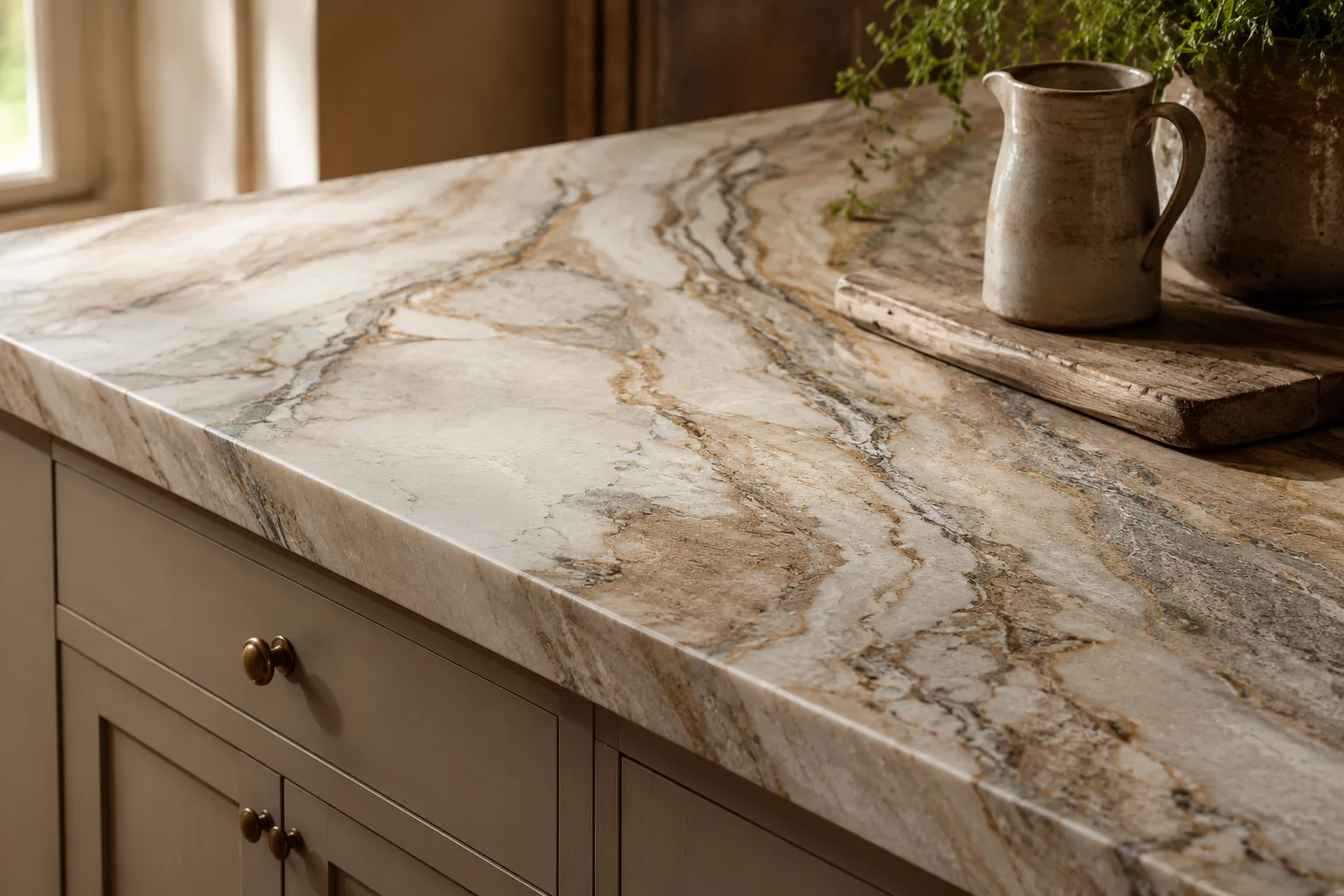
A completely different product despite the similar name. Quartz is engineered; quartzite is natural stone.
It’s hard — harder than granite — so it resists scratching well, and it handles heat considerably better than engineered quartz. The movement in a good quartzite is remarkable. Stones like Taj Mahal and Perla Venata offer marble’s drama with a much tougher constitution, which is exactly why quartzite has been gaining ground.
Two things to keep in mind. It’s natural stone, so it’s porous and requires sealing. And you’ll want to see your actual slab, because every one is different — a photo of a similar slab isn’t the same promise.
One more point worth making plainly: a fair amount of stone is sold as “quartzite” that’s softer than true quartzite and behaves more like marble. Ask the question, and buy from someone who knows the difference and will tell you honestly.
Marble
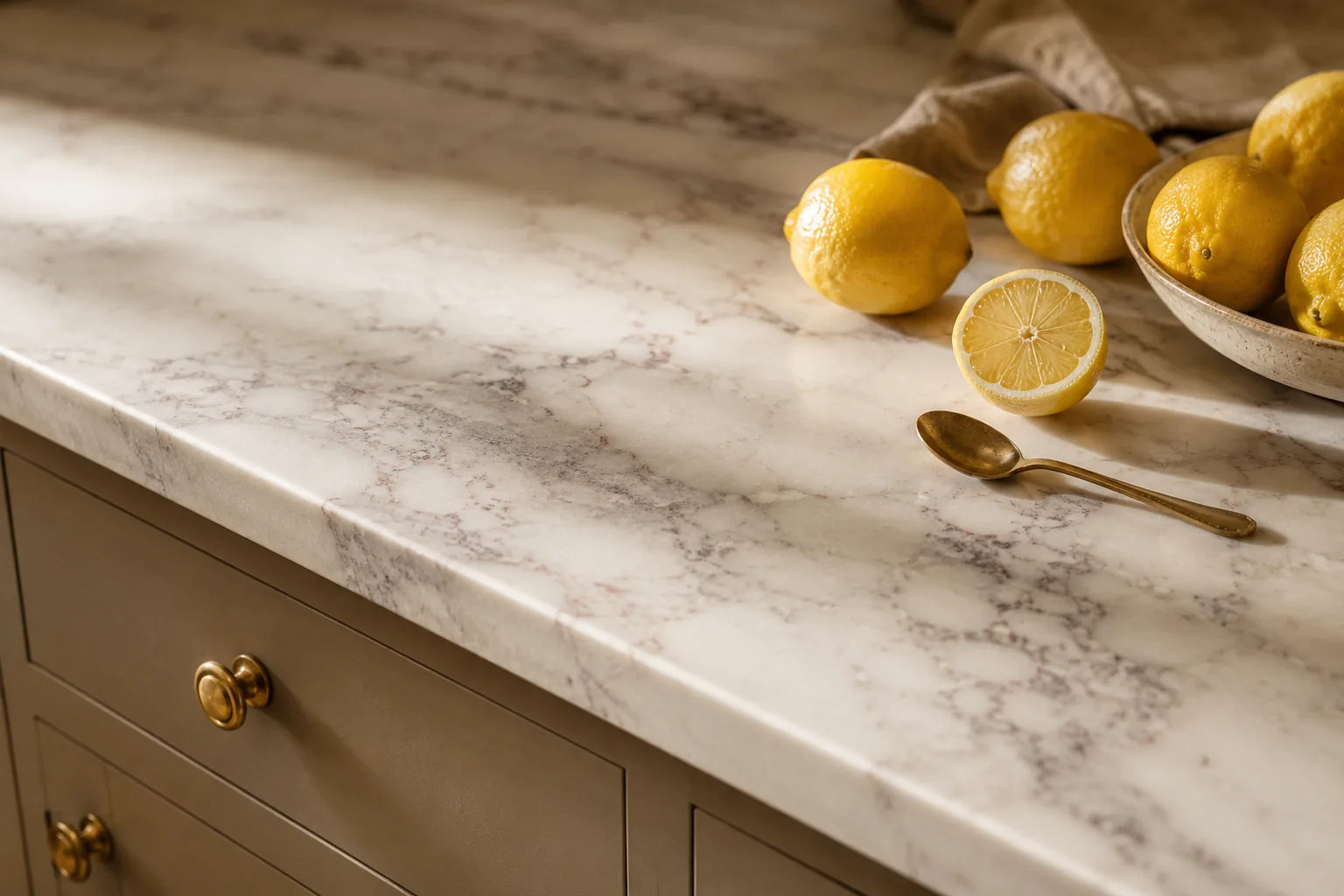
The one in nearly every inspiration photo — Carrara, Calacatta, Statuario, and lately Calacatta Viola with its purple-burgundy veining.
Nothing else looks quite like marble. Engineered stone gets closer every year, but it doesn’t have the same soft, luminous depth. And marble has been beautiful for a couple of thousand years, so it isn’t going out of style next season.
Here’s the part people tend to skip past. Marble is calcium carbonate, and acid dissolves it. Lemon juice, vinegar, wine, tomato sauce — they don’t stain so much as etch, leaving a dull mark in the polish. That’s chemistry, not carelessness. Marble also scratches and stains more readily than most of the alternatives.
That said: in much of Europe, marble counters are covered in etch marks and no one is remotely bothered. The surface develops a patina. If that idea relaxes you, marble may be wonderful for you. If it made your jaw tighten just now, believe your jaw — we’ve seen that go badly for people who assumed they’d make peace with it.
Granite
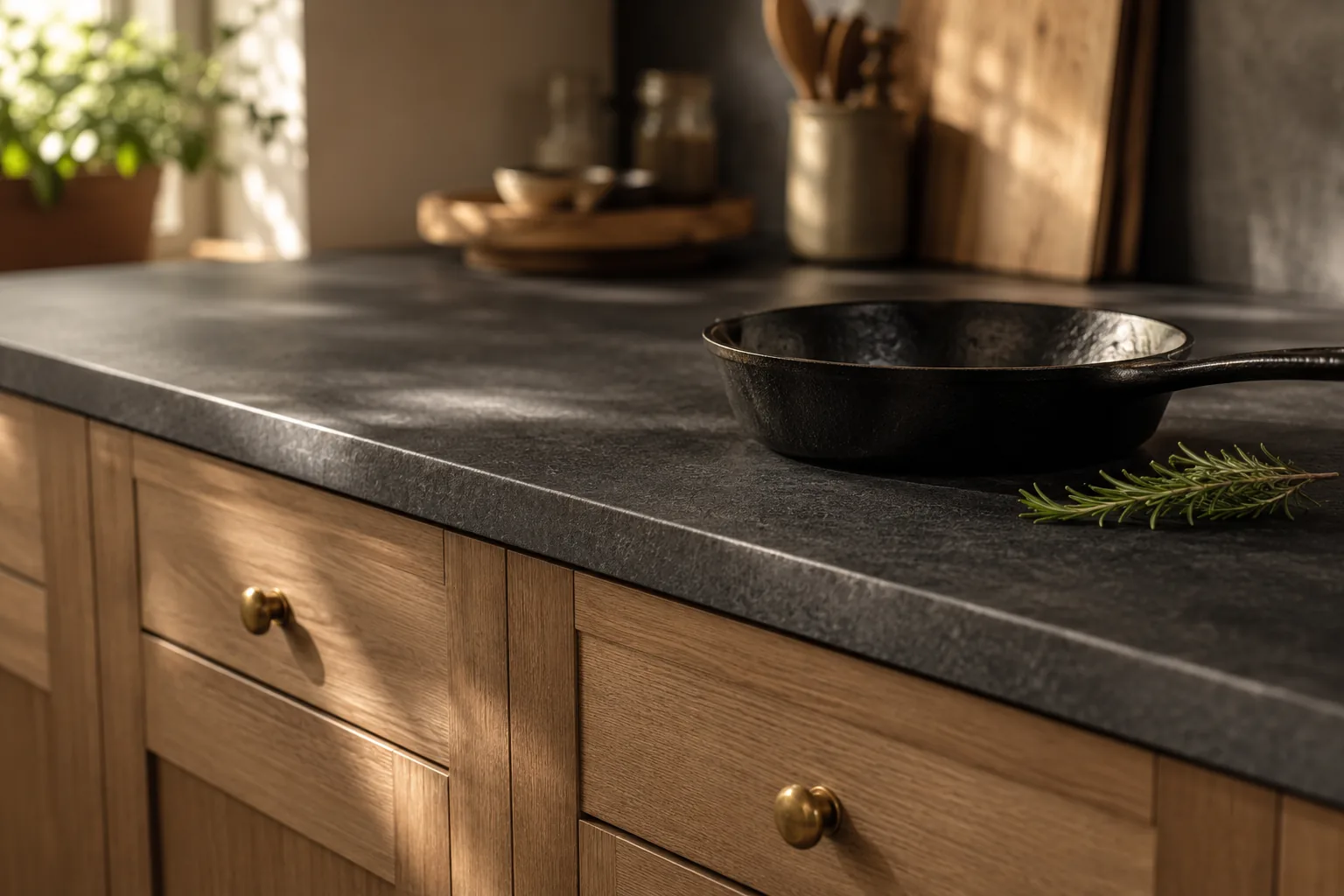
The material everyone had in 2005, which is precisely why it’s been out of fashion — and that’s unfortunate, because it performs beautifully.
Granite is tough, heat-resistant, and difficult to scratch. Today’s slabs also look nothing like the busy brown speckle that gave it a reputation; there are genuinely quiet options and genuinely dramatic ones if you take the time to look. It’s frequently the best value in natural stone by a comfortable margin.
It’s porous, so it needs sealing. Beyond that, granite’s biggest problem isn’t performance. It’s public relations.
Porcelain and sintered stone
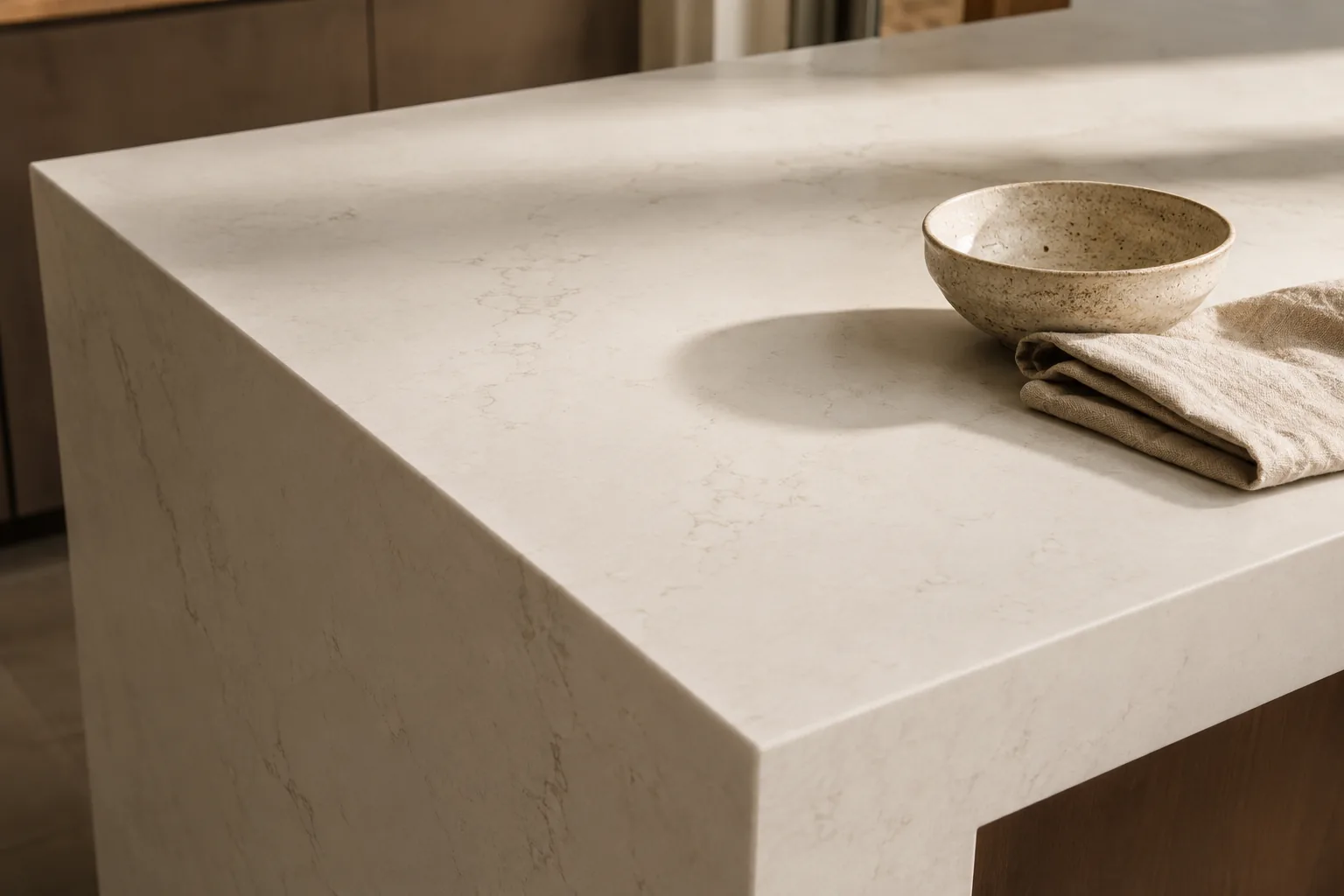
The newcomer, and it’s moving quickly. Large-format slabs fired at extreme temperature — Dekton, Neolith, Laminam and similar.
It’s about as close to indestructible as this list gets: non-porous, highly heat-resistant, UV-stable, and available in pieces large enough to run a substantial island with fewer seams. The printing technology has improved to the point that the veining is genuinely convincing, which wasn’t true a few years ago.
Two considerations. The slabs are usually thin, so edges are handled with a mitered wrap, and the material wants a fabricator who knows it well — it can chip during fabrication in inexperienced hands. And on some products the veining is printed on the surface rather than running through the body, so a deep chip can reveal a different color underneath. Ask whether it’s full-body veining. It’s a good question, and it signals that you’ve done your homework.
Butcher block
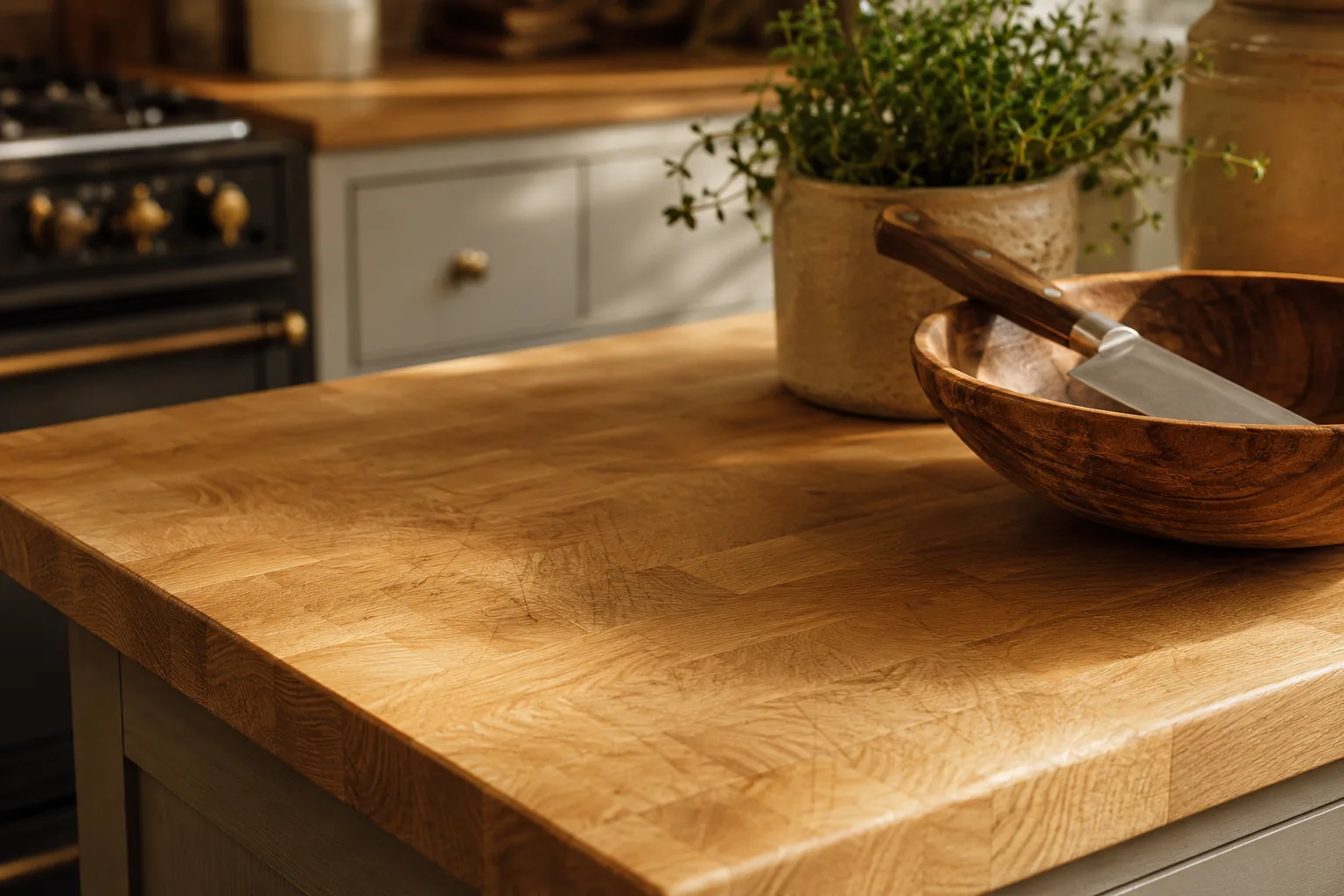
Warmth, primarily. In a room full of hard surfaces, wood is the element that softens everything, and it typically costs less than stone.
It is, however, wood in a room with water. It needs oiling and it will collect marks, and it’s best kept away from the sink unless you’re vigilant. But it’s also the only surface here you can genuinely repair yourself — sand it, re-oil it, and it’s new again. That’s not an option with quartz.
We usually suggest it for an island or a single section rather than an entire kitchen. It works better as the warm note than as the whole composition.
Soapstone
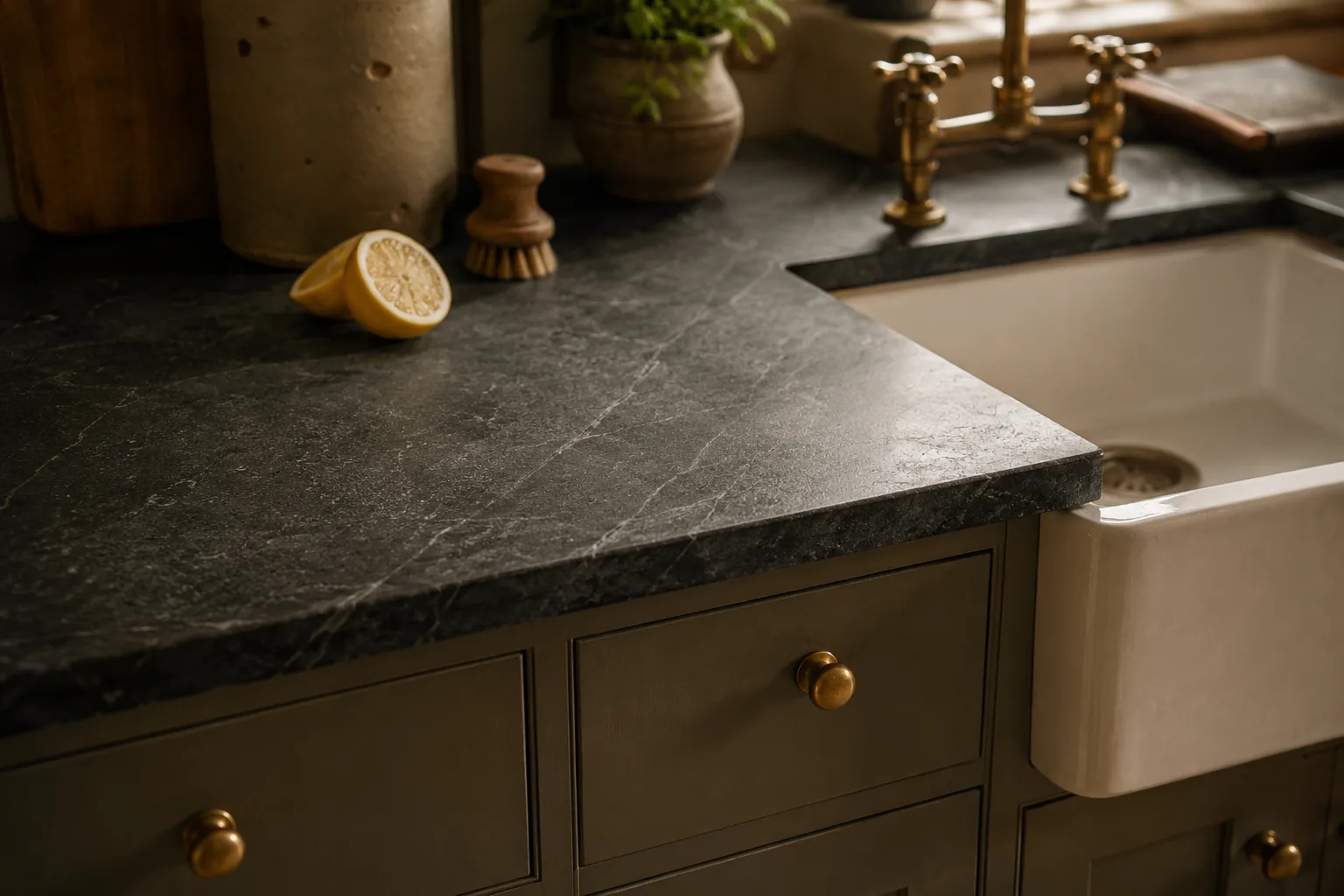
Underrated, and worth more consideration than it gets.
It’s non-porous, entirely acid-proof — use all the lemons you like — and it handles serious heat, which is why it’s long been used around fireplaces and in laboratories. The soft dark gray-green develops a patina over time, and it carries a quiet, older-house character that reads as tasteful rather than trend-driven.
It’s soft, so it scratches — but scratches sand out easily, which is a far better problem than permanent staining. It wants mineral oil to keep the color deep. And the palette is narrow: dark, darker, and slightly greener. If that suits you, it suits you completely.
The questions that actually settle it
Set the materials aside for a moment and answer these honestly.
Do you cook with acid? Frequent citrus, wine, vinegar, tomatoes? That rules out marble unless you truly love patina.
Where do hot pans land? If the answer is “wherever there’s room,” lean toward quartzite, granite, soapstone, or porcelain rather than engineered quartz.
Will you actually maintain it? Sealing natural stone takes roughly twenty minutes a year. The real question is whether that’s twenty minutes you’ll spend, or twenty minutes you’ll intend to spend for four years running.
How much does it need to stay perfect? Some people want a surface that never changes. Others prefer one that shows its life. Neither is wrong — but knowing which you are will narrow this down faster than any showroom visit.
One-of-a-kind, or predictable? Natural stone means going to see your slab. Engineered means what’s in the sample is what arrives on the truck.
Two things that rarely come up until it’s too late
Edges and seams matter more than most people expect. The edge profile changes how the entire counter reads — a thick mitered edge looks modern and substantial; a thin eased edge stays quiet and classic. And in a large kitchen, where the seams land is a design decision, not a manufacturing accident. A good fabricator places them where you’ll never notice. A rushed one puts one directly in your sightline.
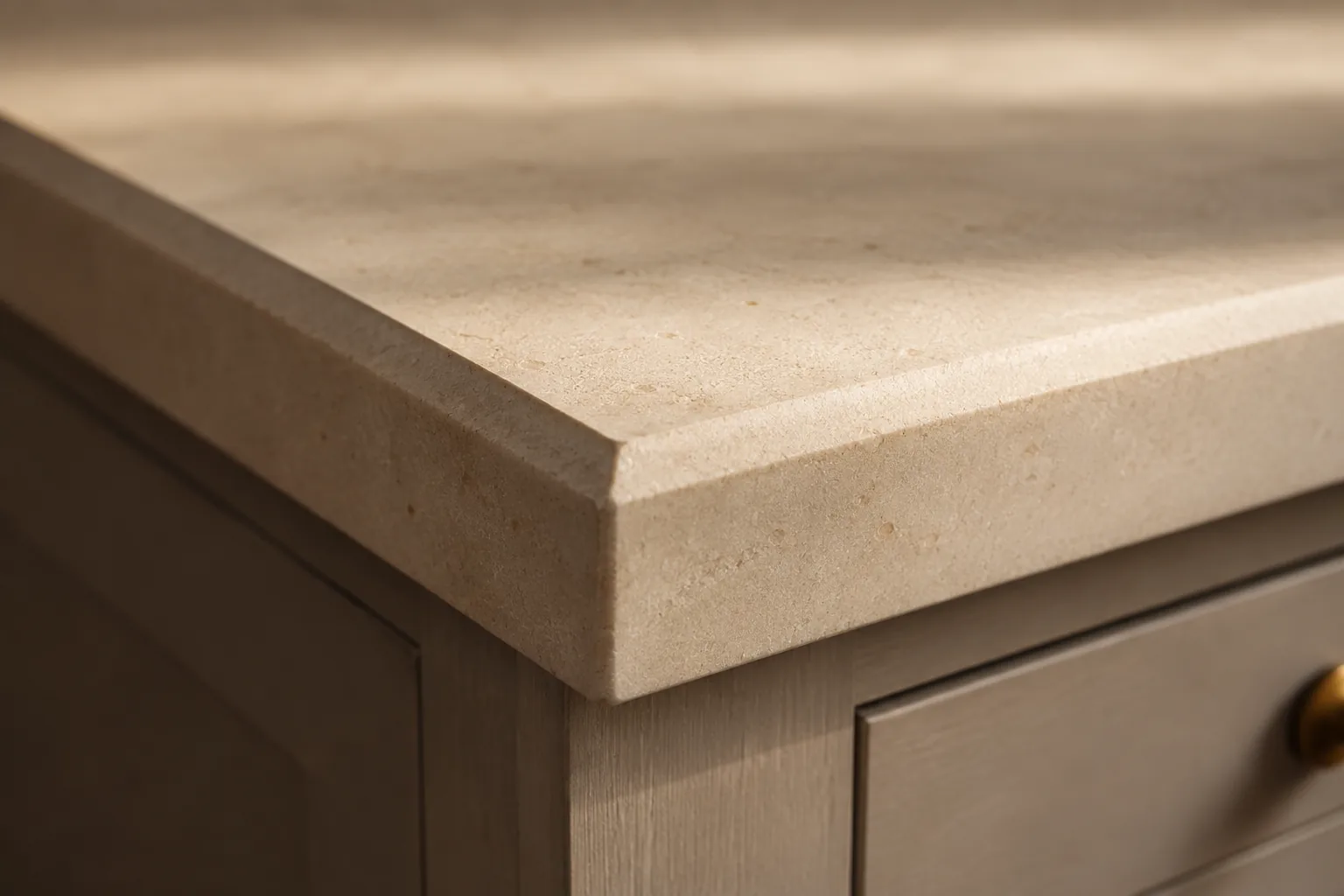
Slab layout isn’t automatic either. With dramatic natural stone, deciding which section of veining lands on the island is the difference between a showpiece and an awkward blob. If you’re paying for movement, you should have a say in where it goes.
So what should you choose?
The short version: quartz if you want easy and predictable. Quartzite if you want real stone that can take a beating. Marble if you love it enough to forgive it. Granite if you want value and durability and aren’t concerned with fashion. Porcelain if you want maximum toughness across a large run. Wood or soapstone if you want warmth and character.
And if you’re standing between two slabs and genuinely can’t decide, here’s the tiebreaker we’d offer: don’t ask which one is better. Ask which one you’d still be glad to see on a Tuesday morning five years from now, coffee in hand, with a scratch on it.
Come see them in person. We carry Cambria, Vicostone, and MSI, and we’d much rather show you a real sample in your kind of light than have you choose from a photograph. We don’t fabricate or install countertops ourselves — that’s handled by fabricators we’ve worked with and trust — but we lead the project from design through installation, so the counters, the cabinets, and the backsplash all end up agreeing with one another.
Bring your questions, and your least forgiving cooking habit.
See the samples in your kind of light
Bring your questions, and your least forgiving cooking habit. No pressure, no obligation.
Book a Free Consultation